Robert Herbin, the Revolutionary Sphinx
When he took over as head coach of the professional team in 1972—having just retired as a player—Robert Herbin faced the daunting task of succeeding Albert Batteux on the bench. His personality and coaching methods would go on to transform the club from the inside out and lead AS Saint-Étienne to the top.
Sphinx: noun (masculine). A legendary creature with the head of a human and the body of a lion that guards sacred sites, temples, and tombs. Put that way, it’s hard to see a connection between this mythological creature and Robert Herbin, born in Paris on March 30, 1939. On the other hand, the connection to Saint-Étienne is obvious: in the capital, “Roby” lived at 99 Quai de la Loire.
Despite this twist of fate, it wasn’t to explore the Loire department more closely that he arrived in Saint-Étienne from Nice—where he grew up—in the summer of 1957. Pierre Garonnaire had spotted him, and, as was often the case, the scout’s eye proved to be spot-on. Fifteen years after his debut, by the time he retired, Robert Herbin would have played a total of 491 official matches in a Saint-Étienne jersey. He would also have scored 98 goals—which, for a defensive midfielder who had been converted to a sweeper, is by no means a disgrace; quite the contrary.
A player one day, a coach the next
Coached by Albert Batteux, who joined ASSE in 1967, Robert Herbin succeeded him five years later. In this regard, he proved to be forward-thinking, as was his custom: as early as 1970, he began studying the profession and made sure to earn his credentials well in advance. At thirty-three, even though he still had plenty left in the tank, he hung up his cleats for good. He traded his shorts for a tracksuit, and his former teammates were now his players. Everything changed, but nothing was lost. Compared to Roby the player, Roby the coach didn’t change one iota—or rather, one octave, one might be tempted to say of this classical music enthusiast. So much so that it’s impossible to tell whether, for him, the trio of Curkovic, Larqué, and Rocheteau was more important than that of Chopin, Mahler, and Wagner.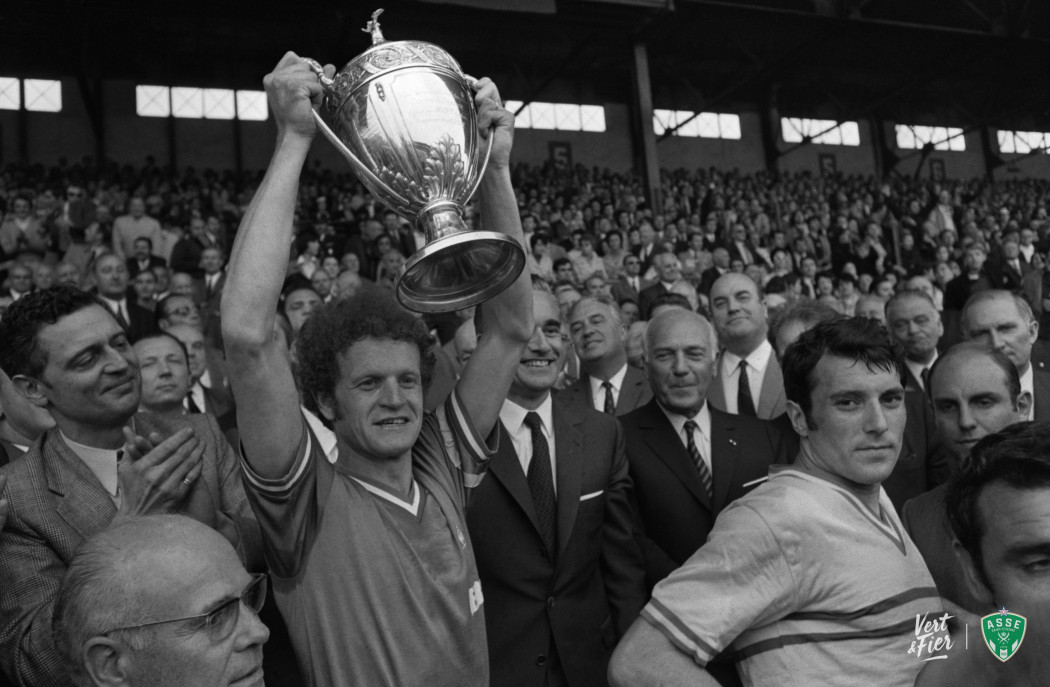
Replacing Albert Batteux—a three-time French champion and two-time winner of the Coupe de France—is by no means an easy task, however. The Reims native remains a legend—and a winner, too. He led Stade de Reims to the pinnacle of European soccer, with two European Cup finals in 1956 and 1959, and helped the French national team shine at the 1958 World Cup. In 1960, he led Les Bleus in the first European Championship. There is therefore much work to be done to continue the legacy of the greatest French coach of his era.
One paw, one vision
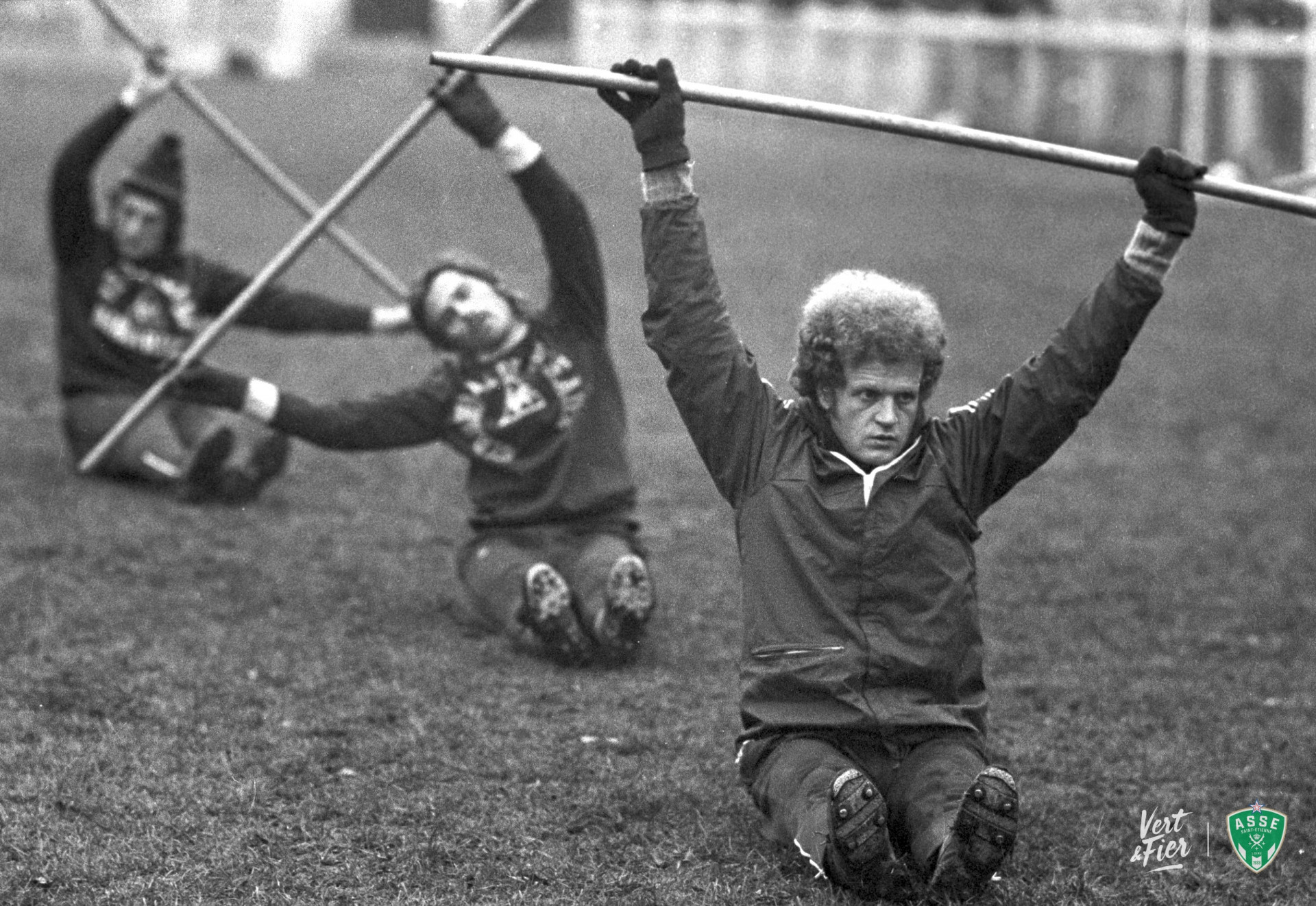
“Yelling accomplishes nothing. As for me, I’ll just stay seated.” Calm. Almost impassive. The Herbin method is, first and foremost, an attitude. During games, the Sphinx lives up to his nickname. In practice, however, he doesn’t go easy on his players. Tuesday’s session, known as “the posts,” is dreaded by his squad. It’s repeated week after week. Les Verts go through a series of runs and sprints, come rain, wind, or snow. With a piercing gaze and his ever-slim figure, he watches his players without flinching. He doesn’t like to see his players push themselves too hard. In Glasgow, before the final, “not a word to the referee” will be the only instruction he gives his team.
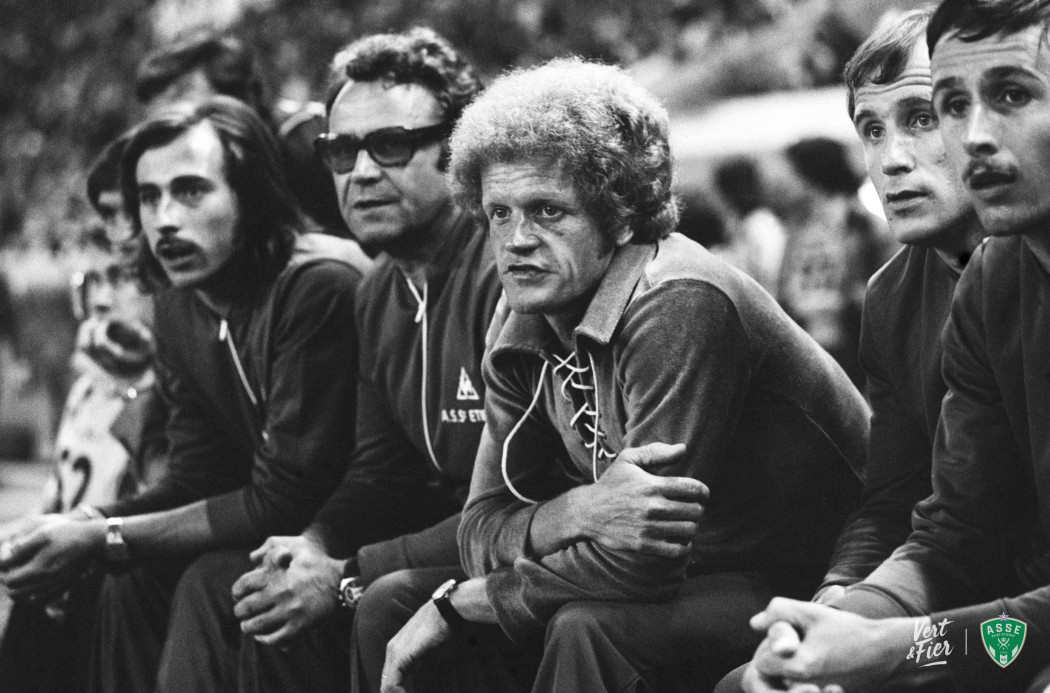
But the coach was also aware of one thing: to keep winning, ASSE had to modernize—starting with its style of play. His inspiration came mainly from Amsterdam, where, at the helm of Ajax, Rinus Michels was revolutionizing the tactical aspects of soccer. “Total soccer”—a style in which players had to be capable of doing (almost) everything—was born. To play this style, impeccable physical conditioning is required. Herbin would make this one of his guiding principles, and his players would quickly come to appreciate it. The Greens would thus get into the habit of finishing matches with a burst of energy, more spirited than their opponents, but also more composed. These were the fruits of the work undertaken during the week’s training sessions.
A Complete Club
Team spirit and pushing oneself to the limit are also essential. They make it possible to overcome giants as formidable as Hajduk Split, Dynamo Kyiv, or PSV Eindhoven—sometimes at the cost of dramatic moments that will allow spectators in attendance to say, for at least fifty years, “I was there.” They also elevate homegrown players—scouted by Pierre Garonnaire, signed by Roger Rocher, and thrown into the deep end by Robert Herbin. In short, it’s all about teamwork, both on the field and in the front office, with the entire club pulling together to excel on the national and European stages.
Although the Champions League ultimately eluded the Verts, it came close to succumbing to Saint-Étienne’s charm. “It didn’t make eyes at us,” Jean-Michel Larqué would say the day after the defeat in Glasgow, even though the attraction between the Big Ears and the Greens was mutual. To beat more prestigious teams and rank among the continent’s top eight teams for three consecutive seasons, Robert Herbin had undertaken a thorough overhaul. Video analysis, in particular, became a regular part of the players’ routine, with weekly sessions and valuable insights gathered here and there to better prepare for major matches. Was Kiev playing a friendly in Nantes before the quarterfinal? The entire club would head to Marcel-Saupin Stadium to watch Blokhine’s squad in action.
Injury recovery and treatment would also be a key focus for management, with the locker rooms at Geoffroy-Guichard Stadium redesigned to ensure players had the best possible conditions. Traveling by plane—for both league and European Cup matches—would help avoid long trips and unnecessary fatigue. Two hours after the final whistle of their matches in Angers, Lille, or Strasbourg, Les Verts were already back in the Forez region, usually at “Le P’tit Coq,” a restaurant that stayed open as late as possible to serve them dinner. The shopkeepers in Saint-Étienne, too, played their part in the team’s social life.
By the way, how did “The Sphinx” come about?
A man of mystery, a man of few words with powerful yet hidden emotions, Robert Herbin once said that he had discovered the meaning of his nickname while completing a crossword puzzle. It was Jacques Vendroux, already a journalist at the time, who had stumbled upon it almost by chance after interviewing the man who had just been named coach of ASSE in 1972. Speaking into the Radio France microphone, he came across as distant, answering in monosyllables and reluctant to elaborate.
“I turned off the mic and told him, ‘Listen, you’re starting to get on my nerves—not even a sphinx has ever done that to me!’ And then Roby retorted, ‘What, do I look like a sphinx?’ (…) That’s it—it just came out like that, and it stuck!” Jacques Vendroux explained to the newspaper L’ÉQUIPE in 2020. He didn’t ask for it, but he handled it with complete composure. As usual.
Derniers articles
“Les Verts 1976: A French Passion”: An Inauguration That Serves as a Tribute
Wed 13 May à 15h20
We loved them movie so much!
Wed 13 May à 14h28
On the Way to Glasgow: A Dream Shattered!
Tue 12 May à 00h00