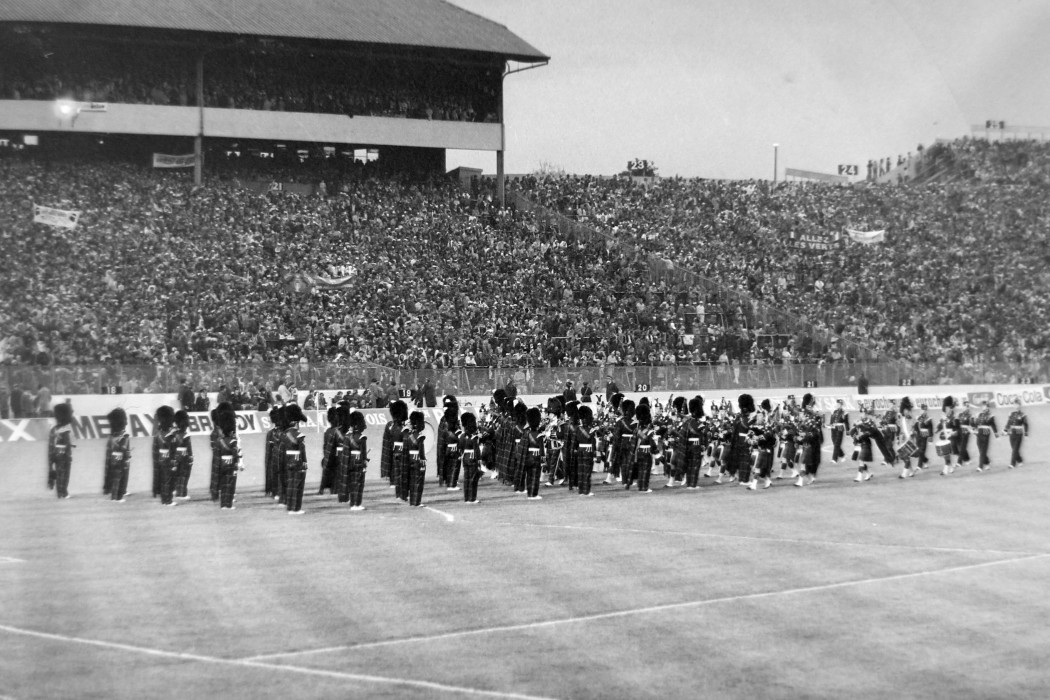
On the Way to Glasgow: A Dream Shattered!
Exactly fifty years ago today, on May 12, 1976, Les Verts lost to Bayern Munich in the European Cup final... but won the hearts of the French!
Eagerly anticipated since Wednesday, April 14, 1976—and the hard-fought qualification in the Netherlands against Kees Rijvers’ PSV Eindhoven (1-0, 0-0)—the big day had finally arrived. The pressure had been mounting ever since Ivan Curkovic’s masterclass on Dutch soil. France, in unison, sang the praises of this admirable team that reflected the nation and with which it was happy to identify.
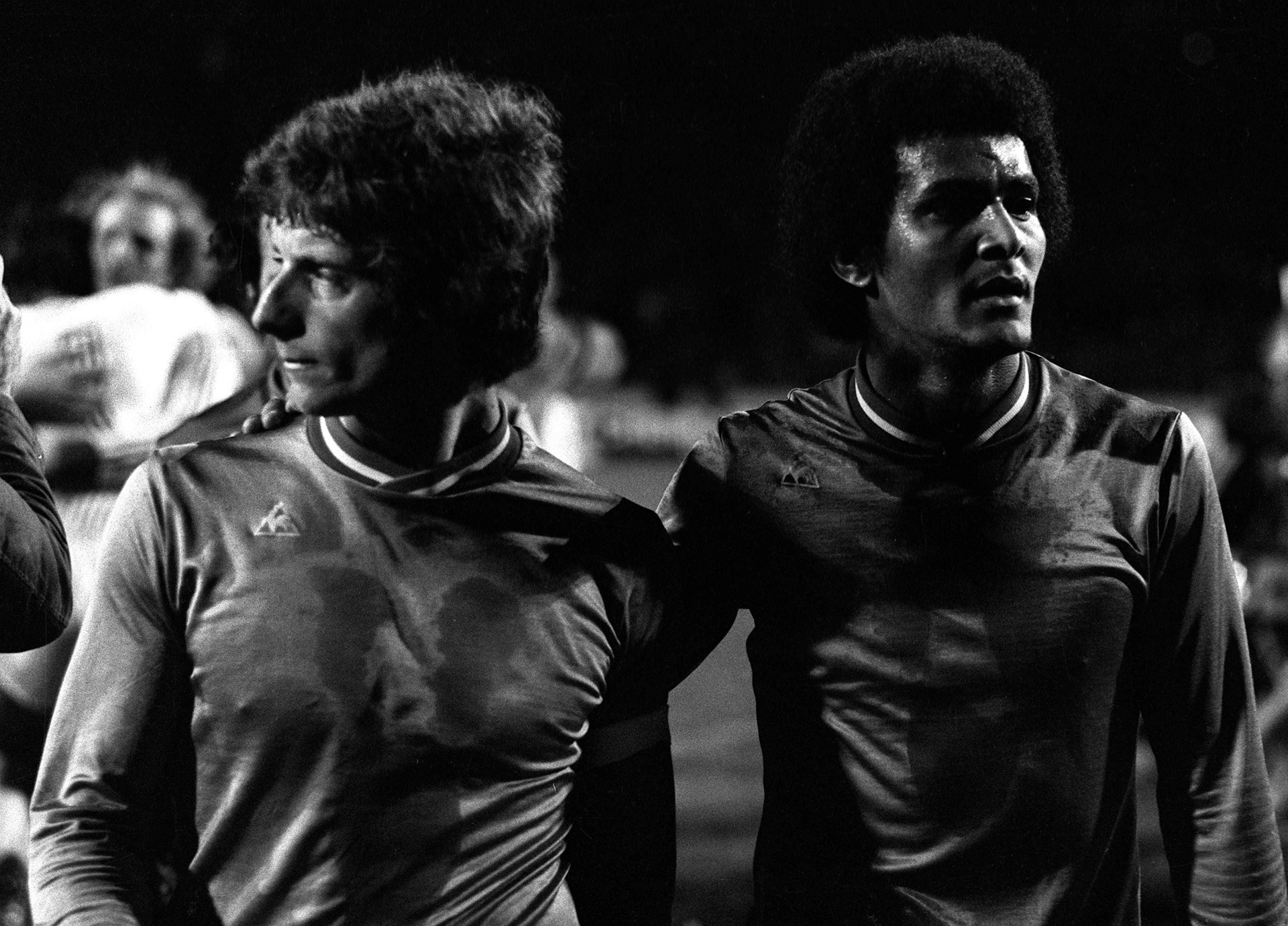
Gérard Farison and Christian Synaeghel on the mat
Saint-Étienne and its soccer players were the center of attention. Their every move was scrutinized, and the team’s form was analyzed and examined closely. Nîmes Olympique, in a match played a week before the final, had indeed lived up to its reputation as an aggressive team that relied on intimidation and did not hesitate to resort to underhanded tactics to achieve its goals. Knocked to the ground after a rough foul, Gérard Farison would never experience “the crowning achievement of [my] career. “I’ve never been injured in my entire career. Why so much aggression?…” wondered “Tachan”—tough as nails, humble among the humble—before breaking down in tears, his heart broken, his dream shattered. He wasn’t the only one watching “the game of a lifetime” from the stands.
Christian Synaeghel also had to withdraw: his metatarsal bore the marks of a particularly heavy-handed Gardoise sole. Despite the care provided by Dr. Poty and Pierre Fillol, the physical therapist, the Chti officially withdrew on May 11. A special insole was custom-made to facilitate movement. The swelling had gone down, but the bruise was severe and located in a very complex bony area. “It’s over for me!” he told the large crowd of press gathered there. The reporters, who had been dispatched in large numbers, were quick to denounce “the unprecedented violence of Kader Firoud’s men, which deprived the Greens of two starters.” One piece of bad news can hide another: it was Dominique Rocheteau’s turn—who had been questionable for about two weeks—to throw in the towel. “As soon as I lengthen my stride, the pain becomes sharp, almost unbearable. So, I’m giving up—yes, I’m giving up.” A goal-scorer against Rangers and Dynamo Kyiv, he would nevertheless take his place on the bench.
Robert Herbin, however, displays an astonishing calm. “In my squad, everyone, in my eyes, has my complete trust—both the regular starters and those who will be called upon to replace them. There are no special statuses. Just quality players, driven by an impeccable spirit, forming a team ready to prevail and capable of competing with the best.” Kiev, the overwhelming favorite, and Tsar Oleg Blokhin—with arrogance and smugness ingrained in their cleats—had learned this the hard way in a seething Cauldron (2-0, 3-0 in extra time). PSV, though forewarned and having spared no effort, had struggled in vain to cling to a qualification that was inexorably slipping away (1-0, 0-0). It was therefore Bayern Munich’s turn—the undisputed giant of the beautiful game—to stand in the way of the little green men with their grand and legitimate ambitions. Although they were two-time defending champions and formed the backbone of West Germany—crowned world champions on home soil in 1974—the Bavarians nevertheless feared this talented, tenacious, remarkably well-prepared, and organized team, which they had defeated a year earlier in the semifinals (0–0, 2–0).
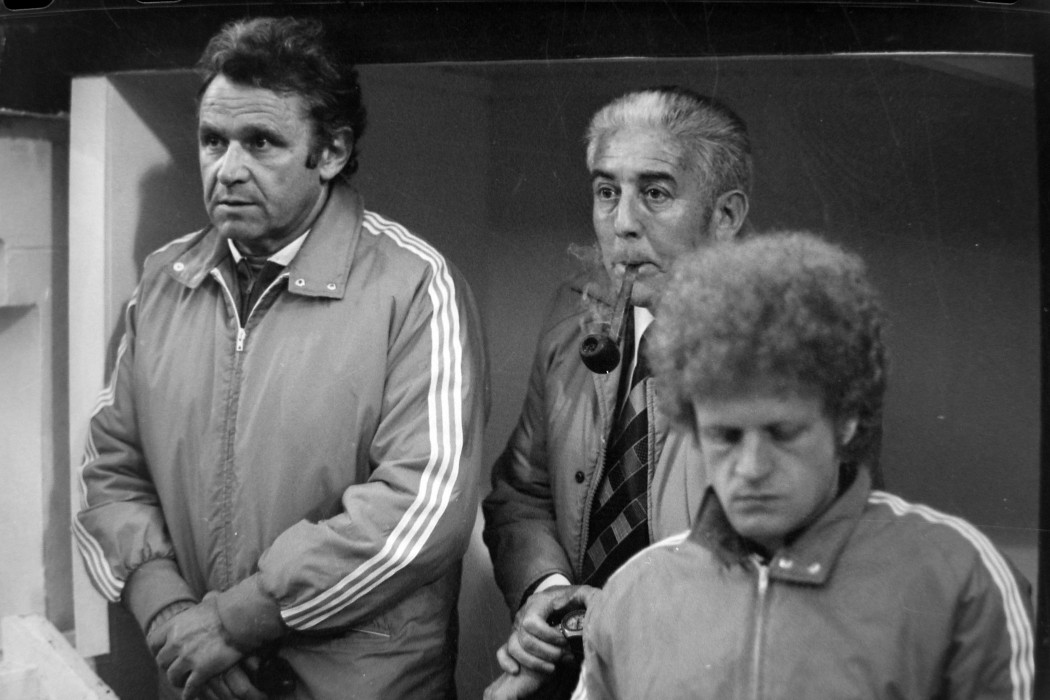
Bayern Knocked Out Standing Tall, or the Curse of the Square Posts
And they were absolutely right, as Jean-Michel Larqué’s teammates played their part with dedication and without ever showing any inferiority complex, not in the least intimidated by the impressive reputation of their prestigious rival. Despite the circumstances and the pressure inherent in such an event—which they made a point of ignoring—the Saint-Étienne players, spurred on by the “Peuple Vert” cheering them on at home, boldly seized their chances. They pushed the Germans to their absolute limits and struck those cursed square posts—now legendary—twice. A left-footed shot by Dominique Bathenay and a header by Jacques Santini both struck the crossbar of a helpless Sepp Maier, who also appeared beaten by a header from Christian Sarramagna at the near post that grazed his left post.
The Kaiser, Franz Beckenbauer, and his troops were on the ropes, battered but saved by the final whistle. Wobbling but still standing, and enriched by the experience of these very special matches that are part of their arsenal, part of their DNA. Les Verts, who held a commanding lead in the standings, had failed to knock out an opponent backed by brazen good fortune. That very fortune would prompt them to take up the gauntlet and land a devastating uppercut to the chin of Les Verts, who were down to nine men.
Free kick but unfare move
A free kick right down the middle, awarded for a minor foul by Osvaldo Piazza on “Der Bomber,” Gerd Müller; a Saint-Étienne team that was slow to get organized; a wall that crumbled; and Franz Roth—who had been nursing an allergy in his legs just the day before—who unleashed a rocket that Ivan Curkovic dived in vain to stop. It was the 57th minute of a final that had just turned on its head. The Germans had seized one of the few opportunities that came their way. The goal seemed questionable in both substance and form, but it was, unfortunately, allowed.Les Verts threw everything they had into the battle. “The Sphinx” played his trump card by bringing in “The Green Angel.” Dominique Rocheteau brought his carefree spirit, his wildness, and his dribbling skills, sowing doubt in the minds of the Bavarians—who were stunned and rattled but knew how to weather their rough patches. The dream was over. The disappointment was immense.
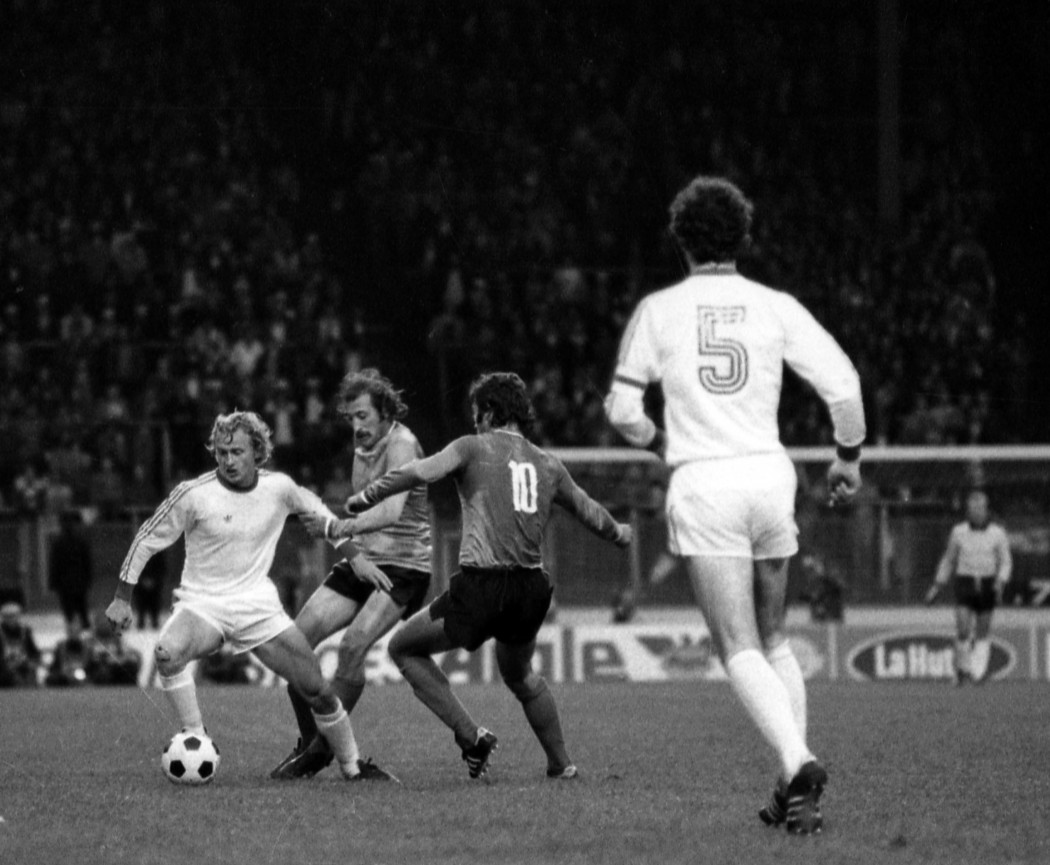
Robert Herbin's elegance
In the wake of the defeat, Robert Herbin analyzed this terrible turn of events—these headwinds, what some were already calling bad luck—with incredible detachment and remarkable clarity. “Efficiency, when it does not resort to illicit means, is not immoral. I don’t see anything wrong with disrupting the flow of the game. On the contrary, in Bayern’s case, I see a very clear awareness of their weaknesses. That’s to their credit. It’s even a sign of intelligence.”
That was also what ASSE was all about in the 1970s—remarkable in defeat as well as in victory. The result of an organization patiently built by remarkable men at every level—from the ground up. With professionalism, selflessness, talent, class, and humility. Fifty years later, this team, this club, still inspires us to dream. Thank you, and hats off to you, gentlemen, for everything you’ve done for the city and ASSE.
Wednesday, May 12, 1976
In Glasgow (Hampden Park), Bayern Munich defeated AS Saint-Étienne: 1-0 (0-0).
Referee: Karoly Palotai (Hungary); 63 269 spectators.
Goal for Bayern : Roth (57e).
BAYERN MUNICH. Maier - Hansen, Schwarzenbeck, Beckenbauer (cap.), Horsmann - Dürnberger, Roth, Kapellmann - Hoeness, Müller, Rummenigge. Entraîneur : Dettmar Cramer.
AS SAINT-ÉTIENNE. Curkovic - Janvion, Piazza, Lopez, Repellini - Larqué (cap.), Bathenay, Santini - P. Revelli, H. Revelli, Sarramagna (Rocheteau, 82e). Entraîneur : Robert Herbin.
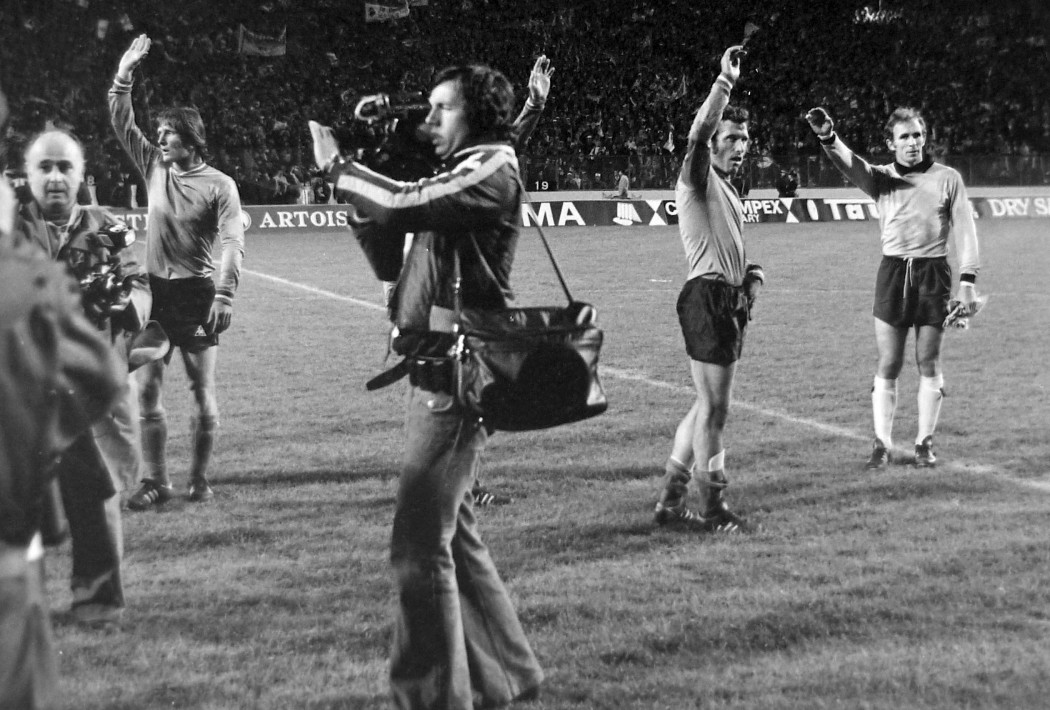
Glasgow andLes Verts : What a Story!
ASSE experienced the thrill of its first European match in 1957, on September 4 to be precise, in a seething Ibrox Park. Rachid Mekloufi, an exceptional playmaker, will forever be etched in the history of Les Verts for opening the scoring before the Scots turned the tables (3-1). Jean Oleksiak, for his part, became Saint-Étienne’s first goalscorer in the European Champions’ Cup, at home on September 25, in a 2-1 victory. It was a frustrating first chapter, given the team’s elimination in the round of 16 against Rangers.Act II saw Les Verts face Celtic on September 18, 1968. At home, Albert Batteux’s men got the job done and secured the win thanks to two goals by Salif Keita and Hervé Revelli. Alas, the hellish atmosphere at Celtic Park, a hostile environment, and lenient refereeing swept Robert Herbin and his team away like a straw (4–0). It was Les Verts’ heaviest defeat in 145 continental matches.
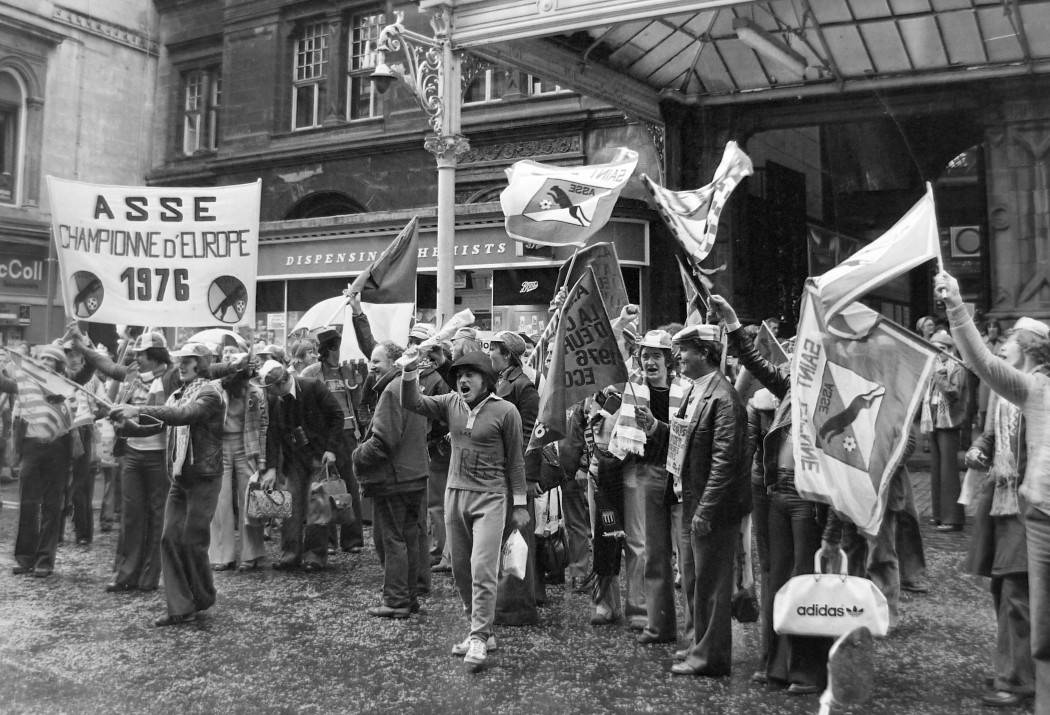
Act III would see Les Verts turn the tide and knock the Rangers out of the Big Ears Cup during the fall of 1975, a season in which victories came thick and fast (2-0, 1-2). Seven months later, on May 12, 1976, the Peuple Vert and its heroes would once again make the trip to Glasgow for an epic final, forever etched in memory—a mix of pride and disillusionment. A legendary team coming up against those cursed square posts and a Bayern Munich side of absolute pragmatism, driven by cold realism and vast experience in these big matches (1-0).